
 Workplace Management
24 September 2026
Best Workplace Management Software in 2026: 6 Tools Compared
Compare six workplace management platforms. See what each is suited for and how to choose the right fit in 2026.

Deesha
|
4 Min Read
Read More


Key Takeaways
HSBC’s CEO Noel Quin gave up his personal desk as part of a wider real estate rethink.
The executive floor is being converted into client meeting rooms and collaboration spaces for better utilization.
Quin noted senior leaders travel frequently, leaving expensive office real estate sitting half-empty most of the time.
HSBC plans to reduce its global real estate footprint by 40% over the next few years.
The bank is introducing a two-people-per-desk approach, aligning with hybrid work and reduced daily attendance.
Hot desking allows employees to choose from available desks, maximizing usage instead of leaving spaces idle.
Globally, unused office space cost organizations billions annually, making hot desking a strong cost-saving strategy.
WorkInSync enables seamless hot desking through desk booking, real-time occupancy monitoring, amenities setup, and sanitization tracking.
Noel Quin, CEO of HSBC, and other senior managers have been asked to relinquish their office desk at its Canary Wharf Head Office. Before you think that this is a ‘fall from grace’ moment, let us confirm that it is not. HSBC has decided to join the latest hot desking trend. The finance giant has decided to reuse the entire executive floor into client meeting rooms and collaboration spaces.
Quin told Financial Times that space was almost always half empty since senior folks were traveling for work, which in real-estate terms was a waste. He also mentioned that as of now, he wouldn’t be in the office all five days since “it’s unnecessary” and “the new reality of life.”
The Bank plans to reduce its real estate footprint by 40% and isn’t going to be renewing a number of its leases due in the coming three to five years. Quin also mentioned that they would be enforcing two employees per desk policy, excluding branches.
But, wait, what is hot desking?
Hot desking is a method of workspace management derived from a 16th-century practice on ships known as ‘hot bunking, where sailors would use the bunk that was available to sleep in. In an office, using hot desking, the employees are not assigned a desk but given the ability to choose from whichever desks are available at the time.
Click here to learn more about Hot desking
The answer to that is quite simple- Cost Saving, especially in this post-pandemic work era where most companies provide employees with the flexibility to work from home or office. Recent statistics show that most employees have said that they would like to split their time between the office and home.
Even before the pandemic, office spaces were grossly underutilized. A study showed that in 2018, 37% of workplaces were empty during any given workday, which was approximately
$150 billion in unused space. With hot desking, organizations can maximize their space usage and cut down on unused office costs, saving a large amount of money.
To successfully implement hot desking in your workplace will require a robust technology solution. Trying to manage hot desking manually can be overwhelming and time-consuming. With WorkInSync’s hot desking feature, employees can book their preferred desk on an easy-to-use mobile app. The app also comes loaded with features such as:
Real-time occupancy monitoring
Employees can also request necessary amenities to be set up at the desk they booked
Track sanitization records for any particular desk
And more.
You can opt for a demo to witness the full capacity of hot desking benefits by clicking here.
 Workplace Management
24 September 2026
Compare six workplace management platforms. See what each is suited for and how to choose the right fit in 2026.
Deesha
|
4 Min Read
Read More
 Announcement
13 August 2026
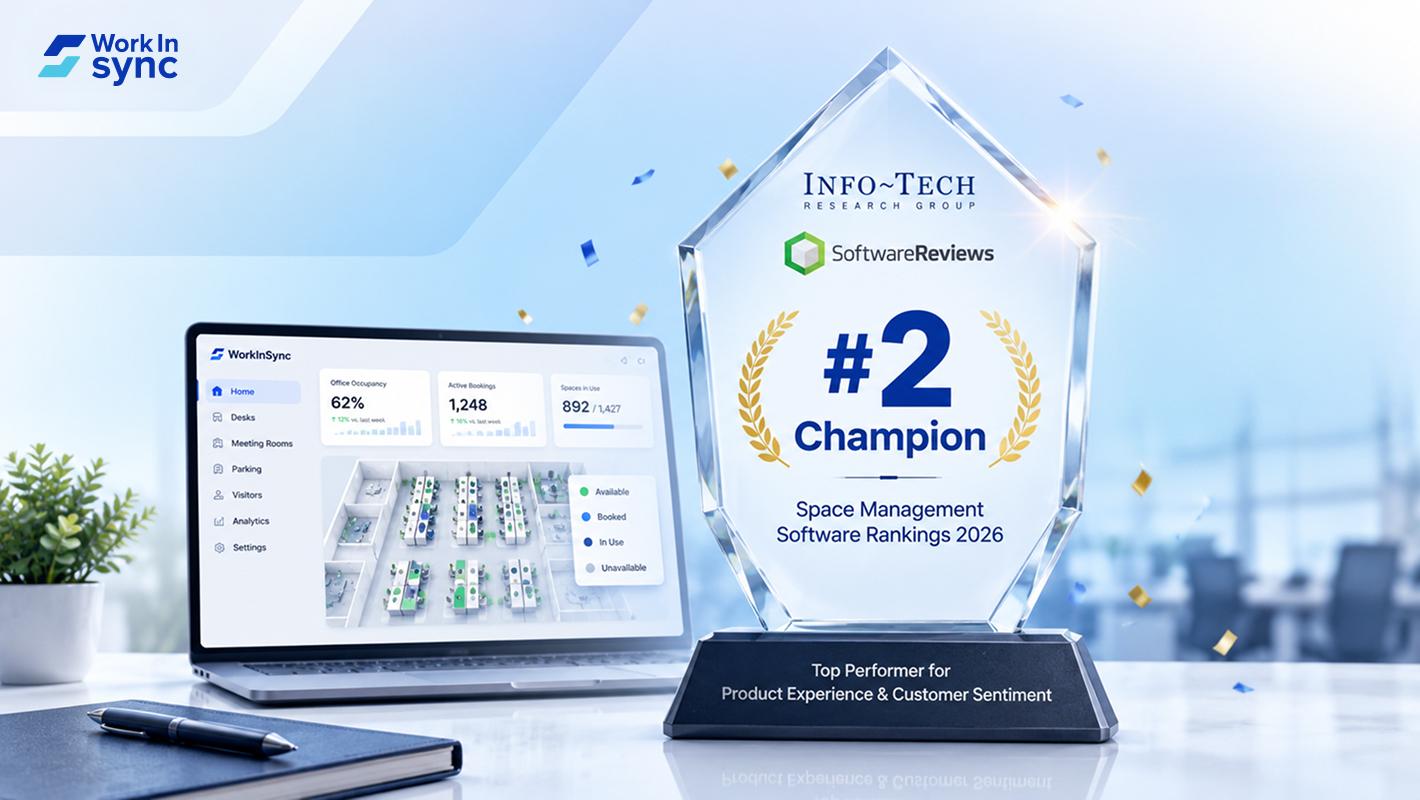
WorkInSync has been recognized by Info-Tech Research Group as a Champion in the 2026 Data Quadrant for Space Management, ranking #2, and as a Champion in the Emotional Footprint, ranking #2. Both awards are published on SoftwareReviews, Info-Tech's ratings platform, where rankings are built entirely from user feedback.

Sai Riddi
|
2 Min Read
Read More
 Desk Booking Software
5 June 2026
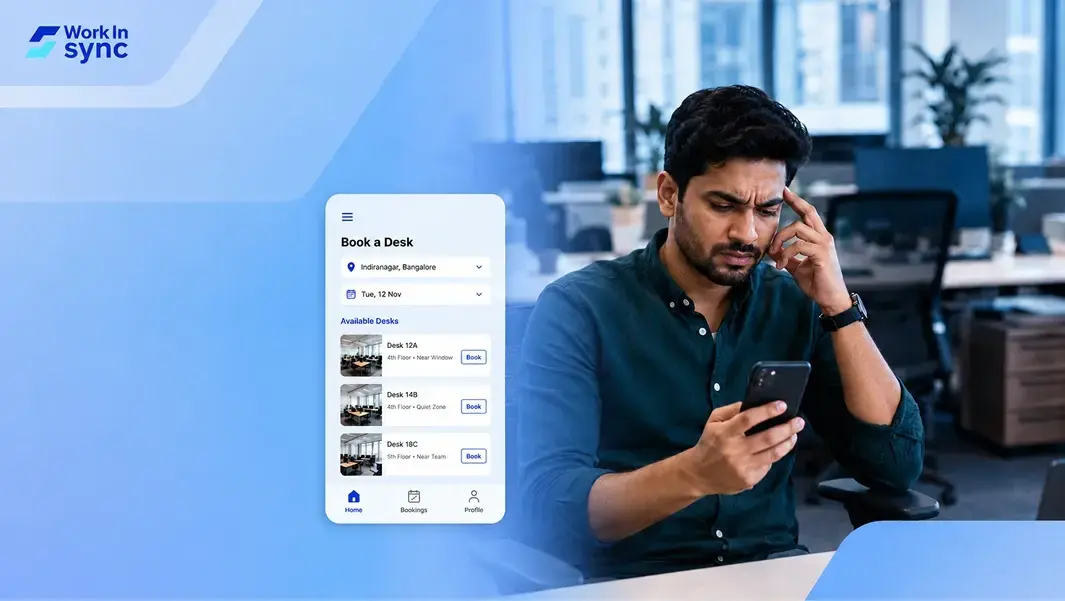
Let’s not pretend otherwise. Somewhere in your organization, a well-meaning IT or facilities team rolled out a desk booking system. There was a demo. Someone said “seamless.” There may have been a slide with the word “frictionless” on it. Leadership nodded. Procurement signed off. And then employees quietly went back to texting each other on […]

Ujjwal Trivedi
|
6 Min Read
Read More